ASSISTANT PROFESSOR
Management
SRM University AP
3
HR analytics, Business Analytics, AI/ML, Blockchain Technology, Innovation adoption, Change management
HR analytics, Business Analytics, HRM/OB
Mail: rukma@sru.edu.in
PhD in HR analytics from SRM University AP
MBA (HR & IB) from University of Calicut
BCom (Cooperation) from University of Calicut
Researcher at SRM University AP, from 2021-11-10 to 2025-04-24.
Assistant Professor at Karpagam Academy of Higher Education, from 2021-01-01 to 2021-10-31.
Ph.D
UG
Sodiq Olaide Bisiriyu, Nafeesathul B, Rukma Ramachandran (2025). Highs, lows, and uncertainty: a deep dive into India’s stock market and policy uncertainty. Discover Sustainability, Springer International Publishing. 6(1), 1024.
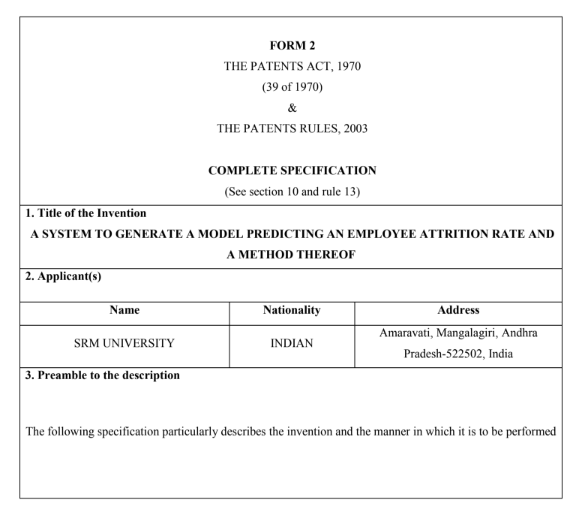
Ramachandran, R., Babu, V., & Murugesan, V. P. (2023). A system to generate a model predicting an employee attrition rate and a method thereof. IN patent office, application number: 202341031320.
Ramachandran, R. & Babu, V. (2023). Revolutionising HR through the deployment of blockchain technology. Blockchain and digital twin enabled IoT networks, pp. 38-58. Taylor & Francis, (Scopus).
Ramachandran, R., Babu, V., & Murugesan, V. P. (2023). Blockchain fragmented clusters for advancing HR saliency: The case of India. India’s technology-led development: Managing transitions to a digital future, pp. 90-120. World Scientific, Singapore. (Scopus)
Ramachandran, R., Babu, V., & Murugesan, V. P. (2023). Human resource analytics revisited: a systematic literature review of its adoption, global acceptance and implementation. Benchmarking: An International Journal, 31(7), 2360-2390. https://doi.org/10.1108/BIJ-04-2022-0272 (Scopus – Q1 ABDC – B) IF = 4.5
Ramachandran, R., Babu, V., & Murugesan, V. P. (2023). The role of blockchain technology in the process of decision-making in human resource management: a review and future research agenda. Business Process Management Journal, 29(1), 116-139. https://doi.org/10.1108/BPMJ-07-2022-0351 (Scopus – Q1 ABDC – B) IF = 4.5
Ramachandran, R., Murugesan, V. P., & Babu, V. (2025). Enhancement of New Random Forest Algorithm to predict the employee attrition rate. International Journal of Enterprise Network Management, (Scopus & ABDC).
The problem of employee attrition in every organization is concerning the employee turnover ratio thereby increasing the cost of investment in human resources. Various factors are reasonable for the rapid attritions at different phased. The purpose of the current study is to predict the employees who are likely to leave the organization. The factors that lead to attrition are identified using Random Forest algorithm. Random Forest algorithm is one of the widely used supervised machine learning techniques for both classificat
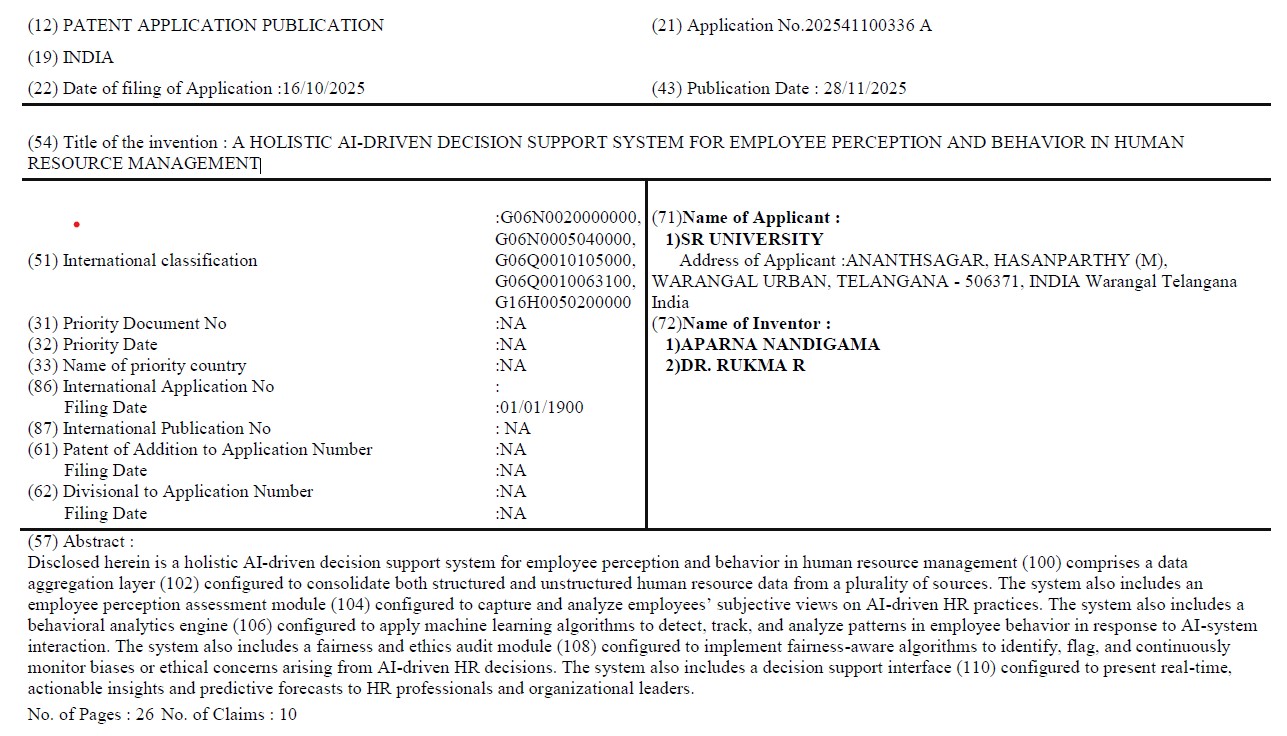
A Holistic AI-Driven Decision Support System for Employee Perception and Behavior in Human Resource Management is an advanced framework that integrates artificial intelligence, data analytics, and behavioral insights to enhance HR decision-making. It captures employee perceptions, monitors behavioral patterns, and provides predictive recommendations to improve workforce engagement, productivity, and organizational culture. By combining psychological, social, and performance-related data, the system enables HR managers to mak

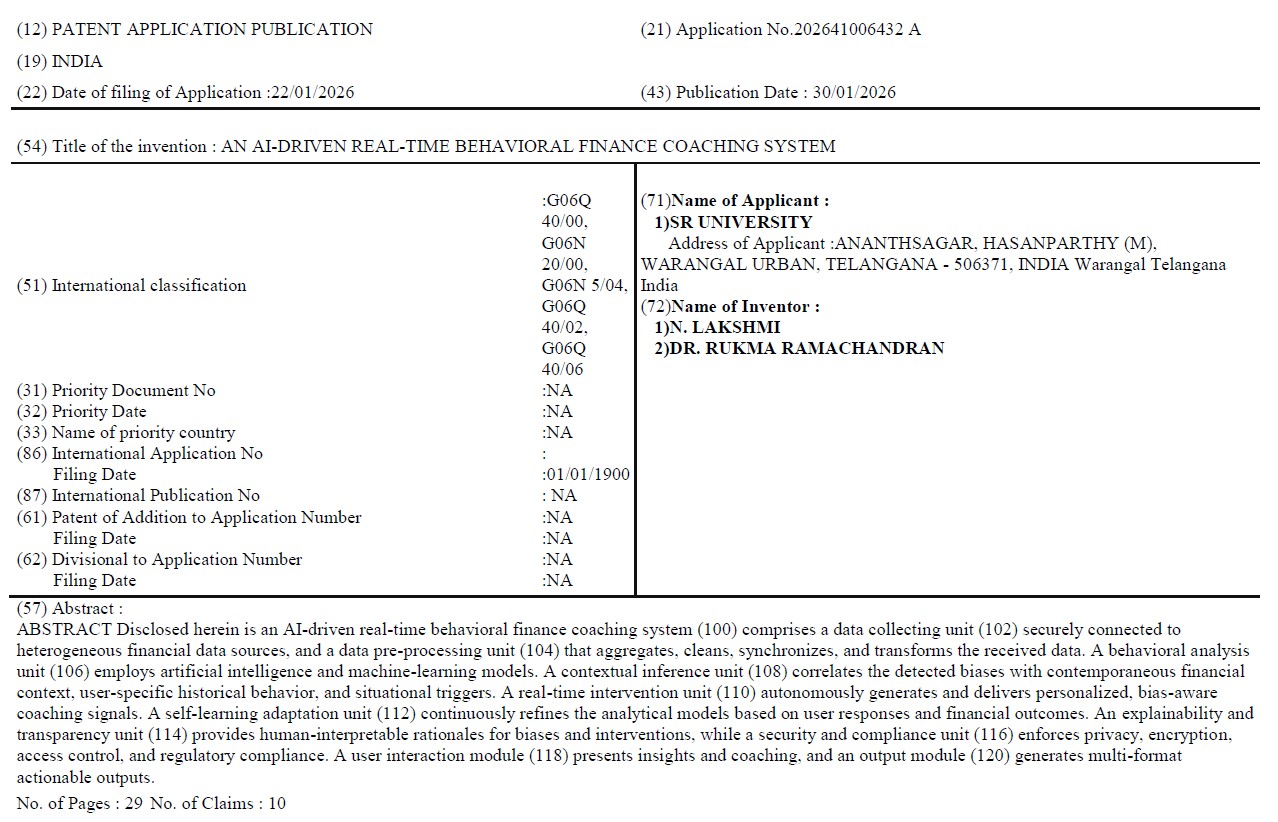
An AI-driven real-time behavioral finance coaching system is a smart platform that uses artificial intelligence to analyze an individual’s financial decisions, spending habits, and investment behaviors as they happen. It provides personalized guidance, nudges, and corrective feedback in real time to help users avoid cognitive biases, improve money management, and make more rational financial choices. Essentially, it acts like a digital coach that blends behavioral science with AI to foster healthier financial habits and long
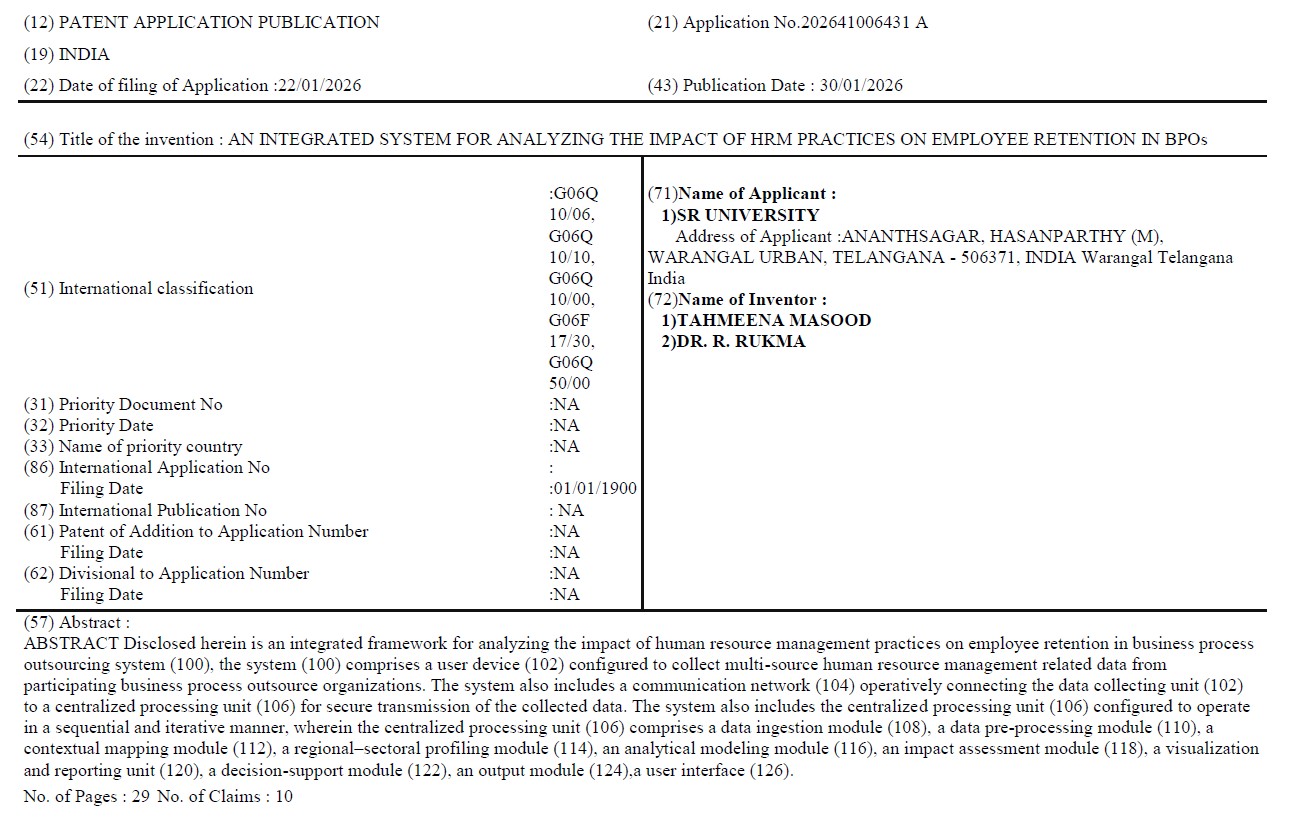
This system is designed to provide a comprehensive framework for evaluating how Human Resource Management (HRM) practices influence employee retention within Business Process Outsourcing (BPO) organizations. It integrates multiple analytical components—data collection, statistical modeling, and predictive analytics—to identify the HR strategies that most effectively reduce attrition and enhance workforce stability
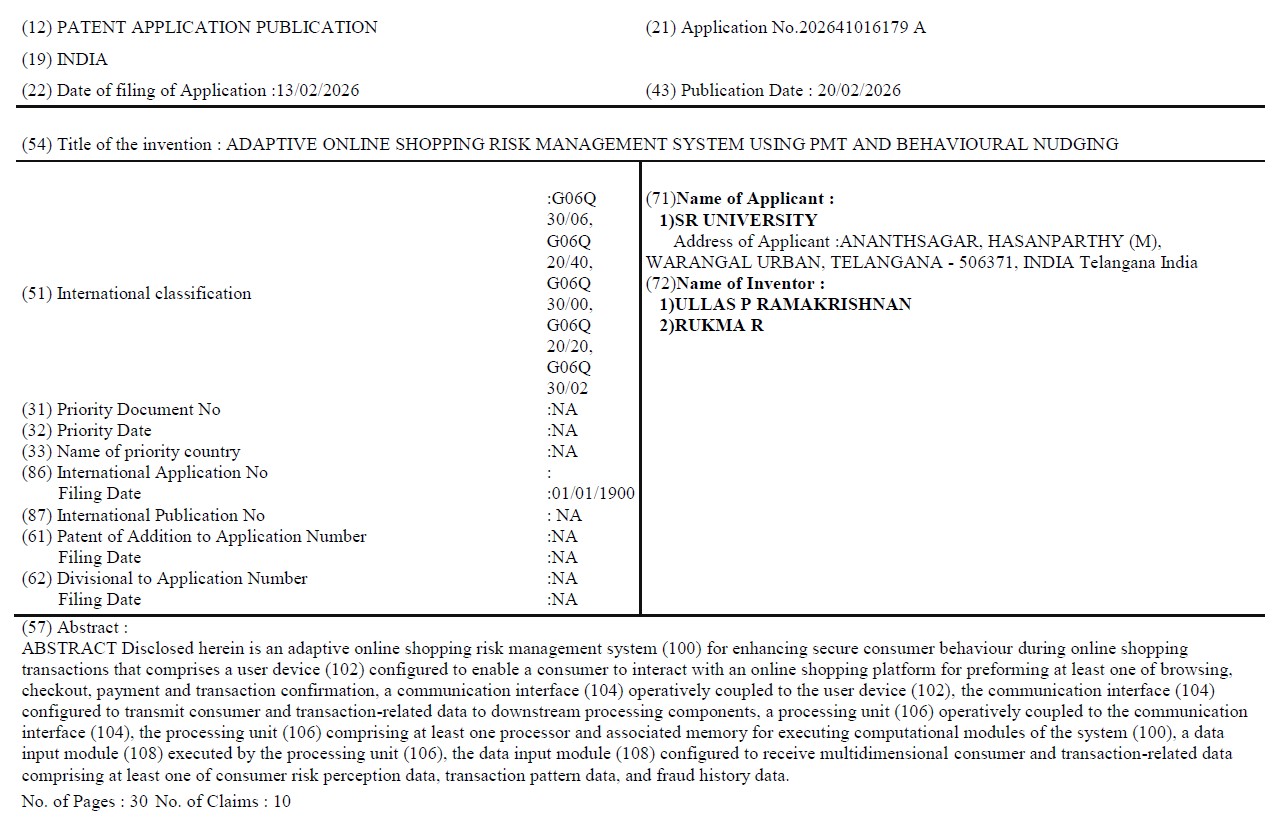
This system is designed to reduce consumer risks in online shopping by combining Protection Motivation Theory (PMT) with behavioural nudging techniques. It adapts dynamically to user behavior, guiding them toward safer purchasing decisions while maintaining convenience and trust.